 STACK
STACKOur Experience with STACK in West Africa: Building Local Capacity in Digital Assessment
Marie Chantal Diawara, Aboubacar Abdou Amadou, Lily Clements: IDEMS International
Who are we and what are we trying to achieve?
We are research methodology support apprentices. We support researchers in their work, particularly in data analysis, and contribute to strengthening their skills in this area across West Africa. Our interest in STACK grew out of these training and support activities. We wanted to explore how digital tools could make learning and assessment more interactive while remaining adapted to users’ needs. In our context, the transition to digital assessment offers many opportunities, but it also requires support to help users become comfortable with these tools and create their own resources.
This is what particularly interested us about STACK. Beyond simply digitising assessments, it allows us to design interactive exercises, generate different types of questions, and provide automated feedback, while still leaving an important role for pedagogical design. Our goal is therefore to encourage greater autonomy in the use of these tools by giving researchers, teachers, and professionals the ability to create, adapt, and share their own resources.
What have we done?
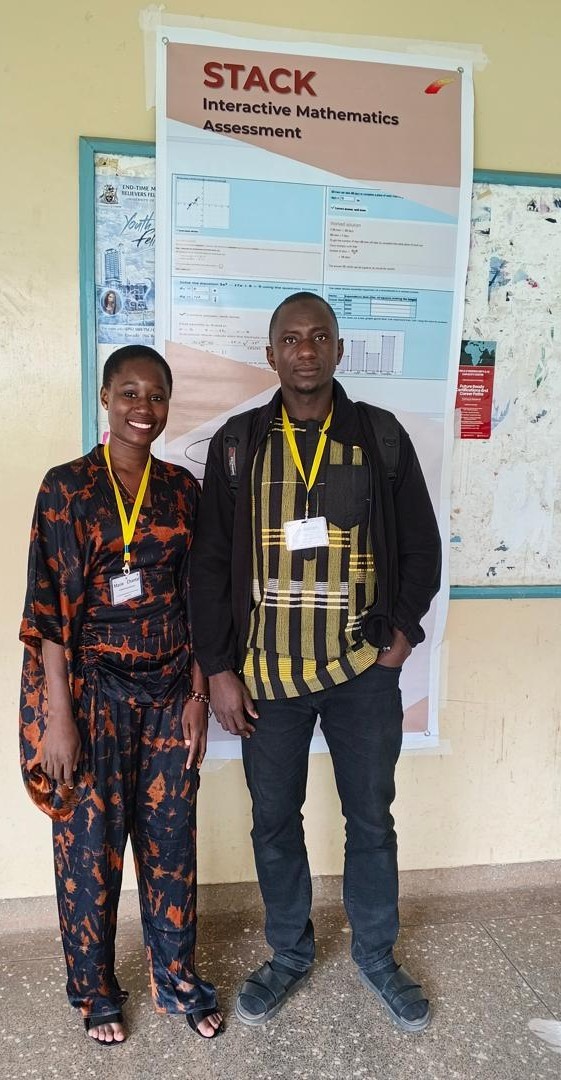
Our experience with STACK has developed progressively through data analysis training activities. We began exploring how STACK could be used to provide learning and assessment activities adapted to our training programmes. This experience also led us to think about how to develop resources that genuinely reflect the needs and realities of users in West Africa. One of the main lessons we have learned is that the adoption of a tool like STACK does not depend only on its technical features. Even when a tool is powerful, it can be difficult to use if people do not have access to the necessary knowledge, examples, and support.
We therefore realised the importance of creating an environment where users can learn progressively, experiment, ask questions, and, above all, share their experiences with others. Language is also an important consideration for us. In much of West Africa, particularly in French-speaking countries, having resources available in French can make it easier for users to discover and adopt STACK.
Our experience has therefore helped us better understand both what STACK can bring to learning and assessment, and the conditions that can support its adoption in our context. This work is also part of a broader set of activities focused on developing data analysis skills and teaching statistics in West Africa, including through research and educational resources developed with different collaborators. Here is an example of an article you may wish to explore: Shifting the Paradigm: A Context-Based Approach to Teaching Statistics in West Africa
What happened and what comes next?
Beyond discovering STACK, this experience has particularly helped us recognise the importance of building local capacity. We have learned a great deal by exchanging with others and by trying to understand what works best in our context. The STACK community is particularly valuable to us as a space for continuing this learning. It allows us to discover what other users have tried, share challenges, and think together about new ways of using the tool.
We also see a real opportunity to develop more resources in French and share them with teachers and institutions in French-speaking contexts. This could help more people discover STACK, experiment with it in their own training activities, and gradually contribute to the wider community. Our next step is therefore to continue strengthening local skills, developing and sharing resources adapted to the West African context, and encouraging exchanges between users, teachers, researchers, developers, and institutions.